
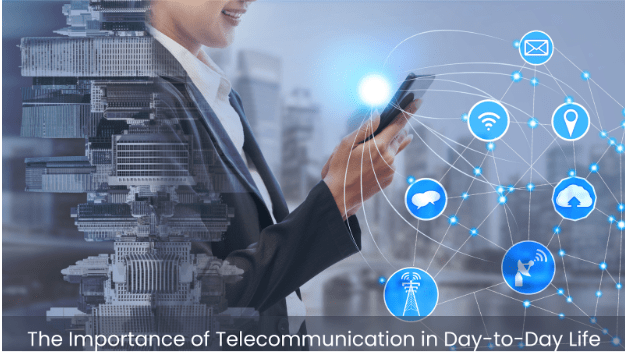
We start the day by taking a look at the notifications, we often end by sending a last message. Between these two gestures, an invisible thread connects our movements, our work, our purchases, our medical appointments and our family conversations. Telecommunications — mobile networks, Wi-Fi, fiber, satellites and submarine cables — have become the nervous system of our lives. They don’t just add speed: they redefine what we consider « normal ».

First, let’s expand the word. « Telecoms » is no longer limited to the telephone. It is the infrastructure that transports the voice, the image, the text, the payments, the urban plans and the sensors of an infinity of connected objects. From the antennas a few streets from your home to the cables that cross the oceans, a gigantic mesh makes the snapshot possible. This quasi-immediacy is not a marginal comfort: it reprograms our expectations. Waiting for an answer, delivery, service — everything becomes « now ».
In the personal sphere, telecommunications strengthen ties despite the distance. Video calls for a birthday, voice messages at any time, photos shared in a family group: relationship continuity is no longer the exception, it is the rule. Diasporas organize cross-border rituals, friendships survive relocations, micro-communities are formed around common interests. This abundance of exchanges also changes the way we tell our lives: fewer big annual stories, more small daily scenes.
On the work side, the office/home border has shifted. Video meetings, team messaging, shared documents: telecommunications have enabled teleworking and the hybrid on an unprecedented scale. For small businesses, it is the possibility of reaching customers outside their neighborhood, cashing in online and coordinating logistics in real time. For employees, it is access to jobs that are no longer limited to a postal code. But it’s also a challenge: the infinity of messages can eat away at concentration time. Here again, the infrastructure is changing practices — and asking for new rules.
Public services and health are also transforming. Making an administrative appointment, receiving a security alert, registering for a social service: access is dematerialized, which speeds up the steps for many. In medicine, teleconsultation relieves congestion in waiting rooms and opens the door to monitoring chronic diseases via connected devices. Emergencies are becoming more efficient thanks to geolocation and priority networks. When everything works, it is fluid; when it falls, we measure how vital the « simple connection » is.
Education follows the movement. Online courses, instructional videos, classroom chats, distance exams: learning is becoming more modular, sometimes more inclusive. A student in a rural area can access a high-level course; an adult can retrain through evening modules. Telecommunications do not eliminate educational inequalities, but they give additional levers — provided you have the equipment, the connection and the digital skills.
Our culture adapts to the rhythm of the networks. Streaming, podcasts, online games and social networks are rewriting the distribution, discovery and monetization of works. Independent creators can find their audience, events are lived live, together, despite the distance. This abundance is exciting, but it is accompanied by an economy of attention: brain time has become a disputed resource. Learning to choose, to disconnect, is part of the new literacies.
On the road and in cities, connectivity is now integrated: real-time routes, carpooling, connected transport, contactless payments. Everyday objects speak to each other — this famous « Internet of Things ». A thermostat exchanges with an application, a sensor signals a leak, a meter optimizes consumption. On an urban scale, these data streams promise smarter fires and better distributed energy. The promise? Increased efficiency. The condition? Clear data governance and outages that do not immobilize the entire system.
Then come the sensitive issues: privacy, security, disinformation. What passes through the networks can be collected, profiled, diverted. Email scams, identity theft or the spread of rumors are now part of the landscape. The answer is not only technological (encryption, strong authentication); it is also cultural: checking sources, learning to spot warning signals, setting limits on permanent availability.
Above all, there is a very real digital divide. Not everyone benefits from the same speeds, the same prices, the same skills. Rural or mountainous areas, certain neighborhoods, certain social categories — and more broadly, entire countries — remain on the margins. The promise of telecommunications is only fulfilled if access is affordable, if the interfaces are accessible to the elderly or people with disabilities, and if training follows. Operators, public authorities, associations and companies have a shared role here.
Another issue, less visible on a daily basis, is environmental. Networks and data centers consume energy; our terminals have a material cost. Efficiency gains (more sober radio standards, optimized cooling, renewable energies) and the extension of the life of the devices can reduce the footprint. On our scale, updating without overconsuming, repairing, reselling, setting the video quality on the move or turning off what may be are gestures that, cumulatively, count.
Resilience becomes crucial. In the event of a natural disaster, cyberattack or conflict, connectivity is a safety net: warn, coordinate, pay, inform. Redundant architectures, satellite rescue, community mesh networks and clear procedures make it possible to quickly restore minimal communications. An interconnected society benefits from thinking about the « degraded mode » before needing it.
And tomorrow? 5G and 6G networks, EDGE computing, new generation satellite constellations and, further, quantum communications, are shaping a denser connectivity, closer to uses, more global. This can multiply robotics, augmented reality, advanced telemedicine, the « real-time » industry. But more power also means more responsibilities: competition rules, net neutrality, data portability, user rights. Technological innovation and legal innovation will have to move forward together.
At the individual level, a few reflexes help to keep a grip: activate double authentication, make regular backups, sort notifications, define slots without screens, check the address of a site before paying, accompany the youngest in their first digital steps, support local services when possible. Telecommunications offer us levers; the way we use them makes the difference.
In short, telecommunications are not a technical decoration: they structure our time, our links, our opportunities and our vulnerabilities. They are moving closer, they are accelerating, they are demanding. To understand them is to live better in our time; to master them is to preserve what really matters: the quality of our relationships, trust, and the collective ability to solve problems. Connection is everywhere — it’s up to us to make it a vector of meaning, and not just a signal.